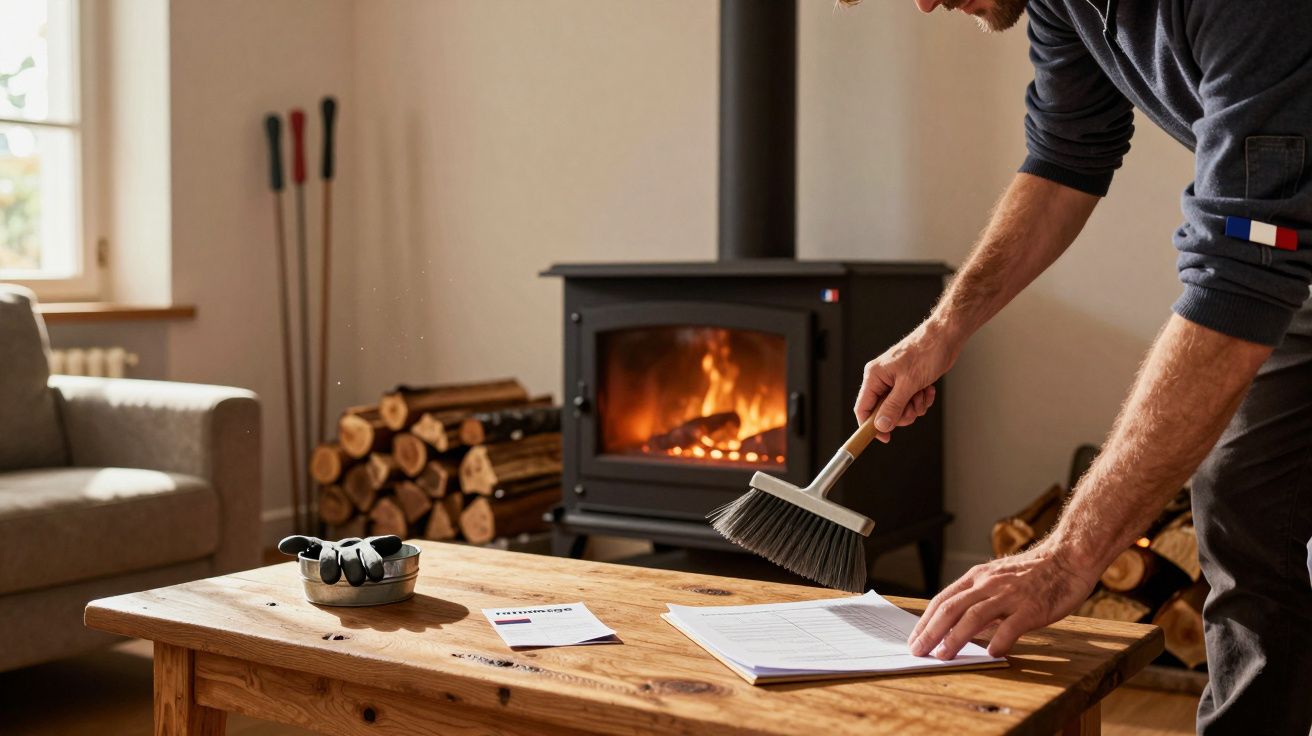
On a rainy November morning in a small town near Lyon, a firefighter showed me the inside of a chimney pipe after a call for a “simple” smoke smell. The metal was lined with thick, glossy soot, almost like black glass. The family swore they used “good wood” and opened the window from time to time. The ramonage date? Nobody really knew.
This is exactly where French law steps in. It doesn’t care how good your wood is, or how careful you think you are. It cares about the state of the flue and the documented maintenance. Ask any insurer: they will mention one thing first in case of a fire – the chimney sweeping certificate.
That little A4 paper can weigh a lot more than it looks.
Take Paris, for instance. The local health regulations require sweeping of chimneys and flues at least twice a year for fuel-burning appliances, with one sweep during the heating period. In many other départements, once a year is the strict minimum for wood and pellets, sometimes twice depending on the local arrêté préfectoral. It’s not just “good practice”, it’s written into the local sanitary regulations that have the force of law.
In 2023, the French fire and rescue services recorded thousands of chimney fires, often traced back to poorly maintained flues loaded with creosote. Official reports tend to be dry, but firefighters will tell you the same story in their own words: the “it’ll be fine” attitude turns into an orange glow on the roof at 2 a.m. Then, suddenly, everyone cares about the date of the last ramonage.
And that’s where insurers start reading the small print on your home insurance contract.
Legally, the obligation to sweep doesn’t come from one shiny national law article that everyone knows by heart. It comes from a mix of the Code général des collectivités territoriales, public health rules, and local regulations set by each préfecture or commune. They converge on a simple rule: the user of the appliance must keep the flues clean and safe, by sweeping them mechanically at regular intervals.
The ramonage has to be done by a professional in most communes if you want a valid certificate, called an “attestation de ramonage.” This piece of paper is what your insurer will ask for if smoke damages the walls or a fire starts in the flue. Without it, they might reduce compensation, or even refuse to cover chimney-related damage. Soyons honnêtes : personne ne lit vraiment ces clauses jusqu’à ce que tout parte en fumée.
The law doesn’t come to knock on your door every winter. The real control happens the day something goes wrong.
How to stay on the right side of the law – and not get burned by your insurer
The safest first move is brutally simple: check the local rules where you live. The obligation is usually written in the “Règlement sanitaire départemental” available on your préfecture’s website, or sometimes on the mairie site under housing or hygiene. Look for the articles on “ramonage des conduits de fumée” and note two things: the minimum number of sweepings per year and whether mechanical sweeping is explicitly required.
Once you have that, call a certified chimney sweep (ramoneur) and ask one blunt question: “Does your certificate tick all the boxes for insurance and local regulations here?” A serious pro will know the local rules, use mechanical brushes, and leave you a dated paper with their SIRET number, address, and details of the appliance. Keep that certificate in the same folder as your home insurance and energy bills. In a crisis, you want to find it in ten seconds, not ten days.
Some households even take a quick photo of the certificate and store it in the cloud. Paper burns. PDFs don’t.
The most common mistake is focusing only on the visible part: the pretty stove, the nice flames, the clean glass on the door. The legal obligation, though, targets the invisible: the flues that run through walls and roofs, where soot quietly builds up. Another classic error is believing that “closed” stoves or high-efficiency pellet boilers don’t need regular sweeping. French law doesn’t care about the marketing leaflet for your appliance; it cares about what comes out of the exhaust.
Many owners also skip sweeping in mild winters, thinking the reduced usage makes it optional. Yet even short burning periods can create deposits, especially with poor draw or damp wood. A mild winter followed by a cold snap is often the perfect recipe for an overloaded flue. The law, in most départements, speaks in years, not in “number of fires lit.”
The emotional trap is easy to understand. Maintenance feels abstract…until the day your living room fills with smoke during a Sunday lunch.
One seasoned firefighter in the Haute-Savoie summed it up to me during an intervention:
“Every time I pull up to a chimney fire, I know I’m looking at a problem that could have been solved with one phone call and 120 euros.”
His words sound harsh, yet they reflect what insurers, mayors and emergency workers repeat over and over off the record.
The legal side often goes hand in hand with simple, everyday habits. Use properly dried wood, keep packaging and treated wood out of the stove, and watch the color of the smoke from your chimney on cold mornings. Dark, dense smoke can be a sign that your flue is working hard and collecting deposits. A professional sweep will usually give small, concrete tips based on your installation and your region’s climate. Those five minutes of chat at the end of the visit are worth listening to.
- Keep all chimney sweeping certificates for at least five years.
- Note the sweep dates in your calendar the day you book them.
- Ask your insurer in writing which frequency they require.
- Check after any major work on your roof that the flue head is still compliant.
Real-world implications: money, safety and quiet evenings in front of the fire
French law around chimney sweeping is not just a theoretical barrier meant to scare homeowners. It shapes very concrete moments in life: the day you rent out a house, sell an old stone home, or install a sleek black stove in a new-build. Not having recent ramonage certificates can slow down a sale, raise questions from a notaire, or trigger negotiations on the final price. Buyers want to know what they’re stepping into, structurally and legally.
On the rental side, things get even more pragmatic. The landlord must usually provide safe, compliant installations; tenants, in many cases, are in charge of day-to-day maintenance like sweeping. Confusion over who pays and who books the sweep still causes tense emails and messages in many shared flats and family rentals. A short line in the lease, spelling out who does what, can avoid months of silent resentment.
The law doesn’t exist in a vacuum; it jumps right into those very human relationships.
| Key point | Details | Why it matters to readers |
|---|---|---|
| Legal sweeping frequency | Most French départements require at least one mechanical sweep per year for wood and pellet appliances, some (like Paris) require two, including one during the heating season. | Knowing your local rule helps you book the right number of visits and avoid being caught off guard by an insurer or a notaire asking for up-to-date certificates. |
| Who must arrange the sweeping | Owner-occupiers handle it themselves; in rentals, tenants usually arrange and pay for sweeping, unless the lease clearly states otherwise or local rules specify different obligations. | Clarifying this avoids arguments between landlords and tenants and prevents gaps in maintenance that could leave someone legally exposed after a fire. |
| Insurance and certificates | Insurers commonly request a professional “attestation de ramonage” dated within the legally required period; without it, they can reduce or refuse compensation for chimney-related damage. | Keeping those certificates and checking your contract conditions can literally make the difference between a reimbursed claim and a very expensive rebuild. |
The more you look at it, the less this subject is about soot and old-fashioned rules, and the more it touches on something quieter: the right to feel safe at home. A flue that works properly is invisible by nature; you almost forget it exists. Until it fails in spectacular fashion. In that sense, sweeping sits in the same mental category as smoke detectors or car seat belts: nobody wakes up excited to deal with them, yet we all know what they quietly prevent.
French law, here, plays the role of the slightly annoying relative who keeps repeating the same advice at every family gathering. It sounds repetitive, but it often turns out to be right. The small ritual of calling a ramoneur once or twice a year isn’t just a bureaucratic dance; it anchors you in a chain linking firefighters, insurers, neighbors and the people who lived in your house before you. Maybe the real question isn’t “Is sweeping really mandatory?”, but rather “How much peace of mind do you want the night you light the first fire of winter?”
FAQ
- Is chimney sweeping legally mandatory everywhere in France? The national framework leaves room for local rules, but almost all départements impose regular mechanical sweeping for fuel-burning appliances through their “Règlement sanitaire départemental.” The exact frequency can change from one area to another, so checking your local text is essential.
- Can I sweep my chimney myself and be covered by insurance? You can use cleaning logs or brushes yourself for extra safety, but many insurers accept only professional certificates as proof of proper maintenance. If you rely solely on DIY cleaning, you risk having no valid document to present in case of a claim.
- How much does professional chimney sweeping usually cost in France? In most regions, a standard sweep for a single flue costs between 60 and 150 euros, depending on access, type of appliance and travel distance. Some companies offer cheaper prices if you book outside the peak autumn period.
- What happens if I never sweep my stove or chimney flue? You increase the risk of chimney fires, carbon monoxide issues and smoke damage in your home, and you may face reduced or refused compensation from your insurer after an incident. In some cases, you could also be held liable if a lack of maintenance affects neighbors or co-owners.
- How can I know the exact sweeping rule that applies to my home? Look up the “Règlement sanitaire départemental” on your préfecture’s website, or ask your mairie’s urban planning or hygiene service for the article on flue maintenance. A local chimney sweep or your building’s syndic usually knows the applicable frequency as well.



Comentários (0)
Ainda não há comentários. Seja o primeiro!
Deixar um comentário